

08 Sep Different types of magic
The Different Types of Magic
Close-up, stage, mentalism, pickpocketing, escapology and more — a working magician's plain-English guide to the many types of magic: what each one actually is, and which suits your event.

Now, before you get all woo-woo on me — this guide will not cover demonic magic from the dark side, life-and-death magic, or spirit magic to summon the ghost of your childhood rabbit (who we miss very much).
Any sane adult knows that sort of thing belongs in a JK Rowling novel at the very most (Harry Potter fans, hi there), and no, we won't be summoning demons to terrorise your ex. What I'm shining a light on instead are the real terms we magicians use for the different types of magic we actually perform — the forms, styles and categories you'll come across when you're hunting for entertainment for your event. Let's take a look.
Close-Up Magic
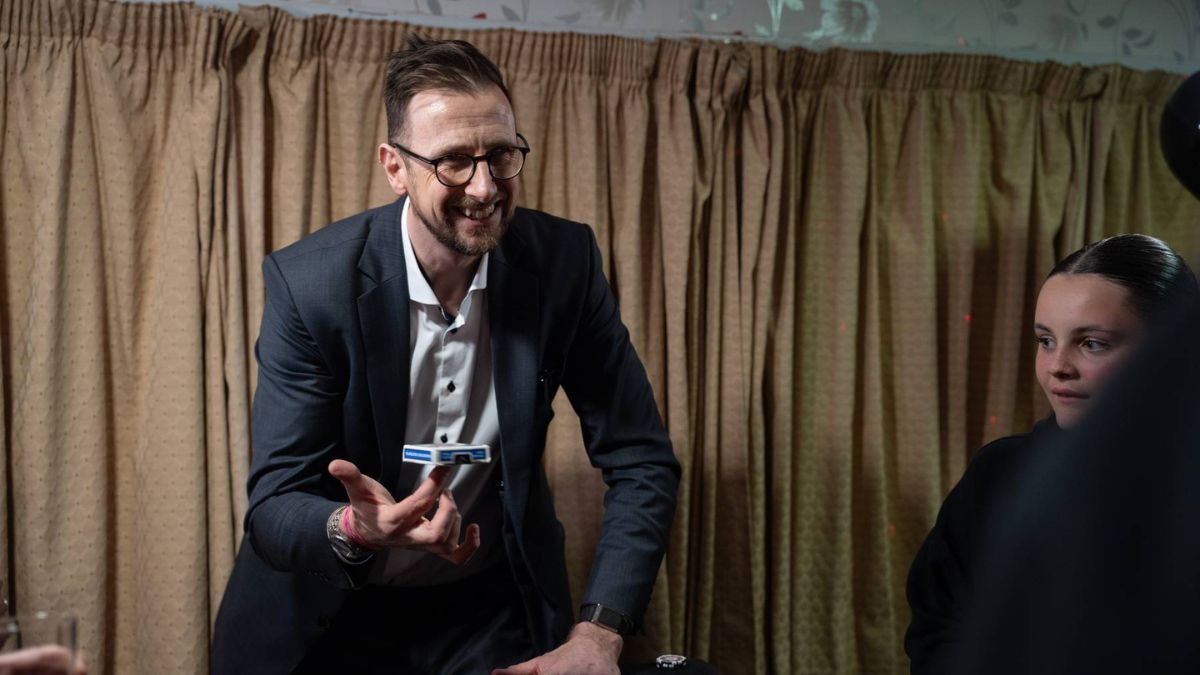
Close-up magic is the go-to entertainment that quietly steals the show at parties, corporate events and weddings. Performed inches from your eyes — "close" is an understatement — using everyday objects, often "borrowed" from unsuspecting guests. Quick, snappy, and perfect for small groups of 1–10, whether they're sat at a table or gathered round.
It's flexible enough to stroll a drinks reception or gala dinner, dropping in spontaneous magic wherever it's needed. Card tricks, mind-reading, rings, phones — the reactions swing from belly-laughs to genuine tears.
It goes by a few names, too: close-hand magic, roaming magic, strolling magic, table magic. Same enchanting experience, different labels.

Stage Magic
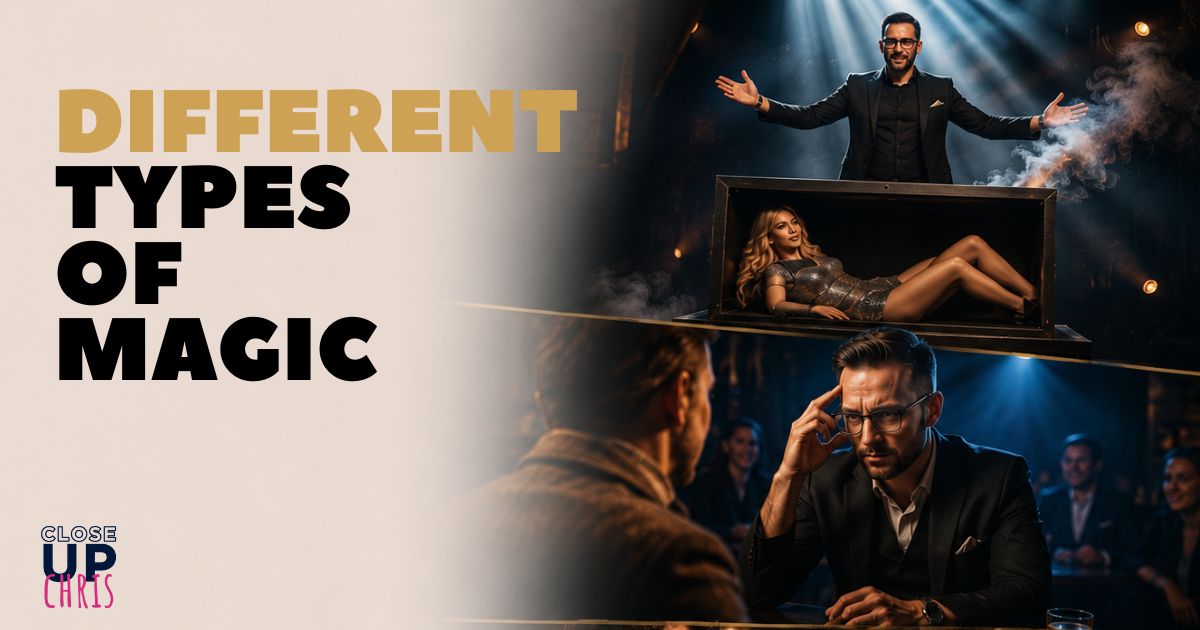
When you've got a big crowd to entertain all at once, step forward stage magic. A stage isn't strictly required, but the scale is bigger — the grand illusions a certain David Copperfield made famous. Big boxes, assistants sawn in half, and other such sorcery. It's all clever principles of illusion, of course — no actual powers — but it astounds a room into thunderous applause.
Where close-up magic works inches from your face, stage magic fills the whole room — playing to anything from 10 to 10,000+, usually with a PA system and a bit of theatrical razzamatazz. The best of it blends illusion with storytelling and audience participation, pulling everyone in.
Cabaret Magic
There's not a huge amount between cabaret and stage magic — think of cabaret as the more relaxed, personal cousin. Sometimes called parlour magic, it sits in the middle ground: bigger than close-up, smaller than a full theatre show.
A cabaret set works for a seated audience of anywhere from 10 to 200 people. It's the sweet spot for after-dinner slots, late-night fringe events and awards evenings — punchy, funny and paced to hold a room that's had a couple of drinks. Where a stage show leans on grand illusion, cabaret keeps the magic close enough that everyone still feels part of it.
Mentalism
Mentalism is the branch of magic that plays with the mind rather than the hands. Instead of cards and coins, a mentalist deals in thoughts, predictions and apparent mind-reading — knowing the word you're thinking of, predicting a choice you haven't made yet, or seeming to influence a decision before you've made it.
It's a slower, more theatrical style than close-up, and it lands hardest when the audience can't work out where the trick even is. Done well, there's no obvious sleight of hand to catch — which is exactly why it stays with people long after the night's over.
Pickpocketing
Theatrical pickpocketing is one of the most jaw-dropping styles to watch live. A skilled pickpocket can lift a watch, a wallet, even the belt off someone's trousers — all while they're chatting away, completely unaware. Then everything's handed back with a grin.
It's misdirection turned up to the maximum: the whole art is keeping someone's attention exactly where you want it while your hands work somewhere else entirely. If you want the full story of how a pickpocket actually learns the craft, I've written about it in the progression of a pickpocket.
Comedy Magic
Comedy magic isn't really a separate trick set — it's a style that runs through everything. The magic still has to be strong, but the laughs are what people actually remember. Get the balance right and a room that started out as strangers ends up in stitches together.
It's the approach I lean on most, because the best reaction to a trick isn't a polite clap — it's a gasp that turns into a laugh. Whether it's close-up round the tables or a cabaret set after dinner, a bit of comedy is what stops magic feeling stiff and turns it into proper entertainment.

Fire Magic
Fire magic brings real spectacle. Flames appearing from empty hands, a fireball produced from nowhere, a torch that vanishes in a flash — it's the kind of thing that makes an audience gasp before they've even had time to wonder how it's done.
It works best as a punctuation mark rather than a whole show: a sharp, dramatic moment that lifts the energy and gives people something genuinely dangerous-looking to talk about. Because it carries real risk, it takes proper practice and respect to perform safely — which is part of what makes it so gripping to watch.
Children's Magic
Children's magic is a world of its own. Forget subtle sleight of hand — this is loud, silly, colourful and interactive, built entirely around keeping a room full of excited kids gasping, giggling and shouting "it's behind you!" It's less about fooling anyone and more about pure, chaotic fun.
It's also one of the hardest styles to do well. A children's entertainer needs the energy of a stand-up, the patience of a teacher and tricks that survive being watched by twenty sets of very sharp little eyes. When it clicks, though, there's no better audience in the world — kids react with everything they've got.
Escapology
Escapology is magic's most nerve-jangling branch. Handcuffs, straitjackets, locked boxes, chains — the escapologist gets themselves trapped in something that looks impossible to get out of, then does exactly that, usually against the clock. Houdini built a legend on it, and it still stops people in their tracks today.
What sets it apart from the rest is the stakes. There's no clever reveal at the end — just genuine skill, timing and a bit of controlled danger. The tension is the trick, and an audience holds its breath the whole way through.
Card Magic
Card magic is where most magicians start — and where a lot of them never stop. A single deck can do the lot: a chosen card rising to the top, four aces appearing from nowhere, a signed card turning up somewhere impossible. It's the classic image of close-up magic for good reason.
The beauty of it is how much lives inside such an ordinary object. Everyone's held a pack of cards, everyone thinks they know what one can do — which is exactly what makes it so disarming when it does something it absolutely shouldn't.
Bizarre Magic
Bizarre magic is the strange, story-driven corner of the art. Instead of "pick a card", it leans into the supernatural — séances, folklore, cursed objects and tales of the unexplained. The trick matters less than the atmosphere it builds, and the goal is to unsettle as much as to amaze.
It's theatre as much as magic, and it isn't for every event — but in the right setting, with the lights low and a good story being told, it gets right under the skin in a way no card trick ever could.
Street Magic
Street magic is close-up magic stripped right back — no stage, no table, no safety net. Just a magician, a couple of strangers and whatever's in their pockets. Made famous by the likes of David Blaine, it's raw, spontaneous and built entirely on the reactions of real people caught off guard.
Because there's nowhere to hide, it's a proper test of skill. The magic has to be clean and the crowd control instant — but when a trick lands in the middle of a busy street, the reactions are as honest and unfiltered as magic ever gets.
Quick Change
Quick change is magic you can see happen and still not believe. In the blink of an eye — a turn, a flick of a cloth, a walk behind a screen — the performer's entire outfit transforms into a completely different one. No pause, no cutaway, just an instant switch right in front of you.
It's a genuinely athletic style, part illusion and part quick-fingered choreography, and it plays brilliantly on big stages and cabaret bills. The reveals come so fast that the applause usually arrives a beat late — the audience needs a second to catch up with what they just saw.
Hypnosis
Stage hypnosis sits right on the edge of magic — no props, no sleight of hand, just the performer, a few willing volunteers and the power of suggestion. People cluck like chickens, forget their own name or freeze mid-handshake, and the comedy comes from ordinary folks doing extraordinary things.
It divides opinion more than any other style, and it's often lumped in with mentalism because both play in the mind. The difference is where the focus sits: mentalism reads the audience's thoughts, while hypnosis turns the volunteers themselves into the whole show.
Coin Magic
Coin magic is card magic's quieter, sneakier cousin. A coin vanishes from one hand and appears in the other, multiplies, melts through a solid table or turns into a completely different currency — all with an object the spectator could examine a second earlier.
It's some of the hardest sleight of hand there is. A deck of cards gives you somewhere to hide the work; a single coin gives you almost nothing. That's exactly why magicians love it — when a coin does the impossible in a bare hand inches from your face, there's simply nowhere for the method to live.
Digital Magic
Digital magic is the newest branch of the art, built around the phones and screens we all carry. A signed card appears inside a locked phone, a thought-of word surfaces in someone's own social feed, or a prediction turns up in a text message that was clearly sent hours earlier. It meets a modern audience exactly where they already are.
Some purists bristle at it, but done well it's every bit as baffling as a classic trick — because the phone in your hand feels like the one thing that couldn't possibly be gimmicked. It's proof that magic keeps evolving: whatever people trust, a magician will find a way to turn it against them.
So, How Many Types of Magic Are There?
The honest answer is that there's no fixed number — magicians will happily argue about it all night. What most people call the different types, forms or styles of magic really break down into a handful of families: close-up and sleight of hand at one end, stage and cabaret in the middle, and the specialist branches like mentalism, escapology and hypnosis fanning out from there.
The big divide worth remembering is close-up versus stage. Close-up magic happens inches from your face, around a table or in your own hands. Stage and cabaret play to a whole room at once. Almost every other style — card, coin, pickpocketing, fire, bizarre — sits somewhere along that line depending on how it's performed.
And the best part? A good magician doesn't stick to just one. The real skill is reading the room and pulling the right kind of magic out at the right moment — which is exactly what turns a few clever tricks into a night people actually remember.
Whatever the occasion, there's a magic to match.
From close-up round the tables to a full cabaret set, the right style depends entirely on your event. If you're thinking of adding a bit of magic to yours, I'd love to hear about it — let's find the perfect fit together.